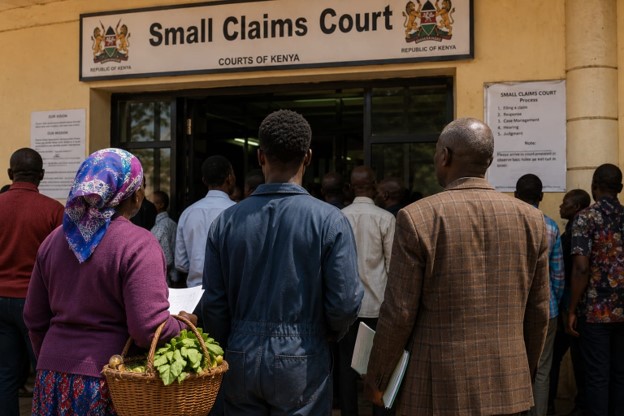
Understanding the small claims court in Kenya: Jurisdiction, procedure, timeline and key exclusions
The Small Claims Court (SCC) has completely transformed the resolution of minor commercial and civil disputes in Kenya. By design, it offers a faster, less expensive, and highly accessible alternative to traditional, drawn-out civil litigation.
Establishment and Purpose
Established under Article 169(1)(d) of the Constitution and the Small Claims Court Act, 2016, the SCC aims to deliver fast-tracked, affordable justice. This court significantly eases the pressure on higher magistrates' courts. Proceedings are deliberately informal, evidentiary rules are relaxed, and the bench actively encourages Alternative Dispute Resolution (ADR) like mediation to settle matters quickly.
Jurisdictional Boundaries
- The Pecuniary (Financial) Limit: Under Section 12(3) of the Act, the Small Claims Court can only hear claims whose total financial value does not exceed KES 1,000,000. The Chief Justice retains the power under Section 12(4) to revise this financial ceiling upward via a Gazette Notice.
- Subject-Matter Jurisdiction: Under Section 12(1), the court primarily hears civil cases concerning:
- Contractual disputes (e.g., unpaid business debts, supply of services/goods).
- Money set-offs or counterclaims arising directly from contracts.
- General tort liability (property damage claims).
- Specific personal injury compensation.
Critical Exclusions (What the Court Cannot Hear)
The Small Claims Court is strictly barred from handling complex matters, including:
- Defamation, libel, slander, and malicious prosecution.
- Land ownership and boundary disputes.
- Employment and labor relations disputes.
Road Traffic Accident (RTA) Personal Injury Claims.
The RTA Personal Injury Exclusion: Following the definitive landmark ruling in James Muriithi Gathaiya v Attorney General & others [2026], the High Court stripped the Small Claims Court of jurisdiction over personal injury claims arising from car accidents. The High Court reasoned that these claims involve complex medical evidence, long-term impact calculations, and negligence tests that do not fit the court's fast-track design. However, straightforward property damage claims from a car accident (such as vehicle repair costs) can still be filed here, provided they are under KES 1,000,000.
Timelines and the 60-Day Rule
By law, all proceedings in the Small Claims Court must be concluded within 60 days from the date the case is filed. Adjournments are heavily discouraged and are capped at a maximum of three exceptional instances per case.
In the case of Wachenje Maghanga v Abeid Walid [2025], the High Court clarified that this 60-day limit is a mandatory efficiency directive rather than a rigid rule that strips the court of its power. If system backlogs or procedural delays push a case past 60 days, the court does not automatically lose jurisdiction; it can continue the matter under strict conditions to ensure ultimate justice is served.
Practical Scenario Example
- The Situation: Client A lends Client B KES 800,000 for a commercial business supply contract with a signed written agreement. Client B defaults after making a small partial payment. There is no land dispute or car accident involved.
- The Legal Advice: Client A should immediately file a Statement of Claim in the Small Claims Court. Because it is a purely contractual debt well under the KES 1,000,000 limit, the matter will likely be heard and determined within a matter of weeks at a very minimal cost.
The Small Claims Court is an exceptionally effective forum for recovering outstanding debts and resolving straightforward business disputes. However, because filing a complex claim in the wrong court can lead to your case being struck out with costly penalties, a proper jurisdictional assessment is vital before you file.
Disclaimer
The information provided in this article is for general informational purposes only and does not constitute legal advice. Prior results do not guarantee a similar outcome. Reading or relying on the contents of this article does not create an advocate-client relationship with our firm. For advice regarding your specific situation, please contact us to obtain professional legal advice with respect to your particular legal matter.
By Ivy Ndirangu